


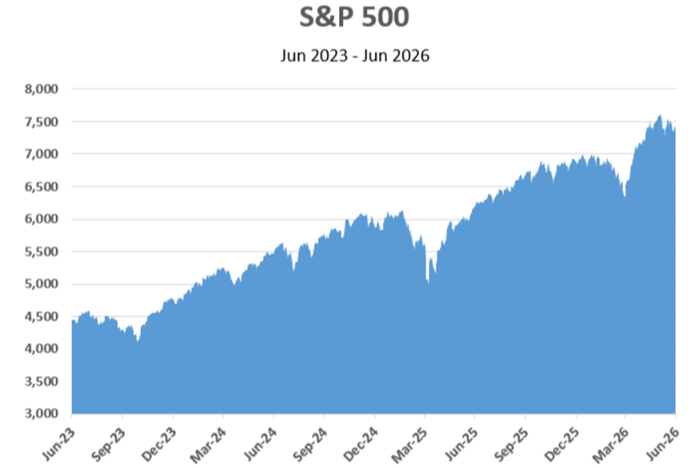
For the quarter which ended June 30, 2026, U.S. stocks rose sharply with the S&P 500 gaining 15.2%. International stocks also rallied, with the MSCI EAFE climbing 10.8%. Bonds increased modestly, with the Bloomberg Barclays Aggregate Bond Index rising 0.7%.
Outlook
Following a weak first quarter, the market bounced back in the second quarter, with the S&P 500 rallying, bringing a gain for the index in the first half of 2026 to 10.2%. Most of the gains occurred in April as the market rebounded 10.5% from a sharp selloff late last quarter in reaction to the U.S. attack of Iran. More modest returns of 5.3% and –1.0% followed in May and June, bringing the gain for the quarter to 15.2%. International stocks also enjoyed a significant rise with the MSCI EAFE gaining 10.8% for the quarter, bringing the international index to a 9.4% gain for the year.
*This graph is not intended to recommend any investment or investment activity.
For the past few years, technology stocks have led the market, with A.I. related companies having been particularly strong. While earnings have been very strong for A.I. technology giants, the market’s enthusiasm for these companies may have gotten ahead of the fundamentals. Although large cap growth has been the dominant area of the market in recent years, value and small cap stocks have outperformed so far this year. The Russell 1000 Growth returned 5.3% in the first half, well behind the Russell 1000 Value which rose 16.3% and the small cap Russell 2000 Index which rallied 22.6%.
Geopolitics took center stage in the second quarter as aggressions between the United States and Iran, which began in March, continued to keep the market on edge. Headlines about on-and-off ceasefires fueled multiple rallies and selloffs. As of this writing, the fragile ceasefire agreed to in recent weeks has failed and the fighting has begun once again. Despite the increased volatility, the market remains near all-time highs.
The war with Iran has created severe disruptions in the energy market. To retaliate against U.S. aggressions, Iran shut down shipping traffic through the Strait of Hormuz. This has effectively cut off oil supplies from the Middle East to the rest of the world. Before the war began, oil traded around $67 / barrel. At its highest, oil climbed to $114 / barrel. As of the end of the quarter, oil has declined back to $71 / barrel.
The disruptions in the energy market, along with ongoing price pressure from tariffs have cause inflation to trend above the Federal Reserve’s target of 2%. As of the most recent measure, the Consumer Price Index has risen 4.2% over the past year. As you can see in the chart below, there has been a notable uptick since the beginning of the war with Iran.
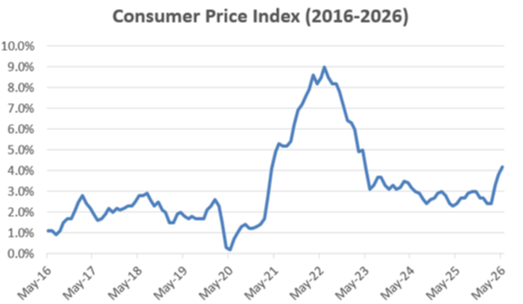
*Source: Bureau of Labor Statistics. Seasonally adjusted, year-over-year change. This graph is not intended to recommend any investment or investment activity.
The crosswinds of higher inflation and a steady economy puts newly appointed Fed President Kevin Warsh in the same conundrum as his predecessor; controlling inflation while facing political pressure from President Trump to lower interest rates. So far, the new-look Fed has indicated a reluctance to cut rates for now, with an eye towards tamping down inflation. Early indications are that there won’t be much change in the direction of the Fed’s monetary policy in near-term.
The market has performed remarkably well so far this year, especially in light of increasing geopolitical tensions. The economy has remained resilient in the face of uncertainty about trade policy, war with Iran, and multiple policy changes. The hope among investors is that the conflict with Iran will be short-lived, and that once the situation has stabilized, the market and economy can continue on an upward trajectory.
Thank you very much for your continued confidence in our service and advice. If you would like to discuss our opinions, outlook, or your portfolio in greater detail, we would be happy to schedule a meeting or a conference call at your convenience. Lastly, don’t keep us a secret. If you know someone who would like help planning for their financial future, we would be pleased to speak with them to see if we can assist.